Showing posts with label limited edition. Show all posts

Buying Limited Edition Prints: What You Need to Know | NZ Fine Prints

Tony Ogle "To the Lookout" limited edition art print

What You Need to Know About Buying Limited Edition Art Prints


If you’re looking into buying a limited-edition print, whether you’re starting out your collector’s journey or are just really interested in purchasing a specific piece, edition info may not be the first thing you think about. Of course, if you have your heart set on a particular piece which you know you love, these details might not change your mind. However, knowing a piece’s edition info not only gives you a greater appreciation for the piece; it also gives you a clearer understanding of the piece’s value, the artist, and of the art market in general. Not sure how to go about buying limited edition art prints? Here are the important factors you will want to consider.


Edition Value

Many pieces of art—whether prints, photography, or sometimes even sculptures—are created in runs. These are multiple original artworks (not a reproduction of an original artwork) using printmaking techniques such as etchings, lithographs, etc. Even though many prints of the piece are made, they are counted by collectors and historians as ‘first edition’ artworks if they are part of a particular set. So, while a piece may not be completely one-of-a-kind, it is still considered unique or rare as part of an original run of prints. These limited-edition groups of works often retain their value very well, as artists usually destroy the materials needed to create extra copies that are exactly alike, such as photo negatives. That said, popular art can be re-printed for second or third edition runs, or even more if demand is high. These limited editions can also be worth more than a standard replication of a piece.


Print Number
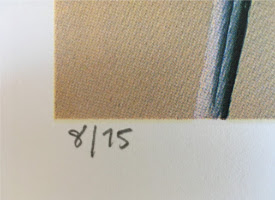
Edition Number Pic
Print Number Example (8/75)
Given that editions get less valuable as they go on—first editions are more valuable than second editions, etc.—many assume this also extends to the number of the print. This is the number given to a piece to identify it within the edition. For example, if there are 20 copies in an edition, your piece may be labelled 5/20, or 13/20, or even 1/20. Contrary to popular belief, however, this number doesn’t impact the value as in general modern printmaking techniques don't wear out soft metal plates etc, which resulted in later prints being of lesser quality. In fact, most artists number pieces randomly, not in the order that they’re printed. Sometimes, the end of the scale (20/20 in our case) can be more expensive, but this is only because galleries tend to list limited edition prints in numerical order. As these run out and stocks run low, demand can lead to higher prices.


Artist Proofs

Limited edition pieces usually also come with artist proofs; look for ‘AP’ or ‘A/P’ in the edition info.
Mickey to Tiki (Reversed)
Mickey to Tiki (Reversed) by Dick Frizzell, featuring artist proofs
Other kinds of proofs exist too, which are provided by the printer, but artist proofs are more common. Artist proofs are popular at New Zealand Fine Prints because these are the first prints to be made, and any adjustments to the printing process are made by the actual artist working on these prints. The proofs themselves can be highly collectable—some of them might have notes or marks made by the artist, and this can make them much rarer and more unique.


Explore the world of art today

If you’re interested in edition info, your best course of action is to talk to the gallery or printmaker selling the prints. Here at New Zealand Fine Prints, we have a range of contemporary collectable ltd edition prints, alongside antique and rare pieces as well as our range of canvas prints, giclee fine art prints, and more, and we’re happy to answer your questions about the differences between all the different kinds of prints that we stock, whether open or limited edition. To find out more, get in touch with us, shop New Zealand’s largest collection of prints online today!

Next Art Prints, Posters & Limited Editions Catalogue - Sneak Peek

We have completed the difficult but enjoyable task of selecting and cataloging just over 500 fine art prints, posters and limited editions for the next New Zealand Fine Prints free mail order catalogue.

Here is a sneak peek at our 2014 catalogue in PDF form (although we have compressed it to 8MB it will take a few seconds to download).

Click here to download Catalogue (PDF)

Printed free versions of this catalogue will be available from early July. Please let us know if you spot any errors before we send this final draft off to the printers!

What we know about an artwork's history changes our enjoyment of it

This morning we watched an insightful and entertaining look at why people like original paintings better than an identical forgery.  In this TED talk Paul Bloom argues that our beliefs about the history of an object change how experience it. And not just as an illusion but a deep measurable change in the way our brain feels pleasure viewing art.


How do we respond when the artworks may look the same but they have a different origin?  Pyschologists have argued that we care so much about origins because we are snobs, as Bloom says "we are focused on status".  So owning a handmade limited edition print is more prestigious than owning a reproduction of the same image because there are always going to be fewer original prints available to buy. Although Bloom doesn't doubt that this does play some role he believes humans are also to some extent "natural born essentialists".   He means we don't just respond to art in the way that we see it, our response is also conditioned on our beliefs about "what they really are, where they came from, what they are made of, what their hidden nature is".  You can own something that looks exactly the same as another artwork but it doesn't have the same history so your respond differently to it. 

Bloom quotes Christchurch philosopher of art Denis Dutton (whom we have featured in NZ Art Print News previously) who wrote "the value of an artwork is rooted in assumptions about the human performance underlying its creation".   Bloom's argument would be that owning an orginal print (which is the product of a creative act, knowledge of materials and technical skill) means the buyer will get a deeper pleasure from owning it than a poster of the same print.   If they were told that it was not an original print their pleasure in owning it would diminish (a case in point is Dick Frizzell's Mickey to Tiki lithograph which was reproduced with the edition number 5/50 on it, occasionally we have been contacted by people given this print as a gift whose pleasure in the gift is lessened when they are told that it is a reproduction although it looks identical to the original print).

It's an interesting question if choosing artworks with a meaningful history - even if they are "reproductions" - can have still give you a deeper pleasure. For instance if you collect only prints by quality artists or fine examples of the best paintings from New Zealand.  NZ Fine Prints try and stock only meaningful artwork, we have never understood the part of the market where custuomers are looking to buy art to "match the curtains".  I guess this touches on the prestige or snobbish element of art ownership alluded to by Bloom as a motivation of buying artwork for your home or office because your choice of art is a way of demonstrating to others your degree of artistic sophistication or level of art appreciation.  But for Prints.co.nz making a distinction between meaningful art and pure decoration is a way of helping us decide what we choose to stock at a "fine art" print specialist.

Two New Editions from Tony Ogle

Tony Ogle Print Hammock and Bach
NZ Printmaker Tony Ogle
Reputedly "Cathy's place at Bethell's [Beach]" "Hammock and Bach" was Tony Ogle's last print of 2010.  As with all of Ogle's fine art prints "Hammock and Bach" began as a detailed painting on board from which each individual colour is then hand separated. These separations became the stencils on the screens through which each colour is printed (some Ogle prints have up to 25 individually printed colours). The printing process involves a careful alignment and registration and constant checking for quality problems. The colours of all Tony's prints are hand-mixed and give the image a very real handmade feel and quality.  Hammock and Bach is an edition of 200. (NB for readers outside of NZ "bach" is the coloquial New Zealand expression for a holiday home).

Caravan Window, Tony's first print in 2011
Tony's first print of 2011 is "Caravan Window".  Here the kiwiana style beachside scene is cleverly framed by an oval window that echoes the shape of the caravan windows in the foreground.  A tyre rope swing hangs from the branches of the pohutukawa tree.  Edition of 180, image dimensions 450 x 180mm.   Tony subscribes to single edition productions only, he says "a true Limited Edition Fine Art Print [should be] limited to one edition, each being numbered and signed individually by the Artist. Once the Edition has sold out it should not be repeated otherwise the value of the works is compromised."   In the long term this is what gives the artworks value over time.

What is an original print?

I have been having an interesting discussion with Tony Ogle and Brad Novak about how we can best explain the differences between original prints like screenprints and reproduction prints. They have come up with some suggested additions to our FAQ.

What is an original print?
Original prints encompass different media such as screen prints, lithographs, etchings, woodcuts, linocuts and monoprints. Within an edition, each print is individually pulled from a screen, plate, or block. Generally created as limited editions of archival quality, and because of the skill and effort required to produce them, original prints potentially have a high investment value.

What is the difference between a giclee print and an original print?
Giclee prints are created using the Giclee printing process which uses a very sophisticated digital printer to deliver a fine stream of ink onto archival paper. Original prints differ, encompassing several media such as screen prints, lithographs and etchings (amongst others). Each print is individually pulled from a screen, plate, or block to create limited editions of archival quality.

How is an original print produced?
Original prints are produced in many different ways, generally as limited editions. The main techniques include screen printing and lithography. Each print is individually pulled from a screen, plate, or block. Their creation involves the mastery of a printing press with the artist often solely or heavily involved in the process.