Showing posts with label Maori Portraits. Show all posts

Portraits: Why Are They So Common in Art? | NZ Fine Prints

Portraits: Why Are They So Common in Art?

Painting of knight in front of castle surrounded by other people


There’s no doubt that portrait art is one of the most common art types, and that this has always been the case. But why are portraits so prevalent, both in the history of art and today? In this blog post, we’re going to explore why portraits are so popular, and so common in many different movements of art!


1. Making portraits paid well

Historically, painters could count on portraits when they needed income. This idea grew out of the practice of ‘court painting’, wherein painters like Fransisco Goya were kept on retainer to create paintings of royalty. For a lot of history, commissioned work like this was basically the function of art; the idea of ‘personal inspiration’ is relatively new to modern society! A huge amount of historical art began not with the painter themselves, but with someone else paying the painter to create a piece. It's probably worth mentioning that this idea is drawn mostly from the European tradition of art, which we’re focusing on in particular, because it’s more or less where a lot of the formal ideas about portrait painting come from. Many of the most famous European paintings of all time are, in fact, commissioned work, including the Mona Lisa! And it’s easy to understand why people were eager to pay artists to paint themselves or their families, because it was the only way to keep images of loved ones before photography existed everywhere in the western world. The movement away from commissioned portraits is though to be relatively slow. It began as a practice reserved for the rich, but slowly became more accessible for lower classes in European societies, until eventually, painters simply began painting portraits of people they knew, or even strangers they happened to see.


2. People like people!

The next big reason portraits have always been popular is very straightforward; we’re social creatures! Humans enjoy looking at other humans, and portraits were one of the first ways we could reproduce the experience of looking at someone. There is more to it than that, of course. On a deeper level, portraits can also reveal all sorts of interesting things about their subjects. Part of this lies in the decisions that are made by the artist. How have they chosen to represent the subject of the painting, and what does this say about how people viewed the subject at the time? With older paintings, it can be a full-time job investigating the historical context surrounding these questions, but they are still engaging to think about for anyone, whether they collect art or not. Portraits can also tell us a lot about someone from the level of detail alone. A great example is the oil painting Virgin and Child with Canon van der Paele by Jan van Eyck. The painting depicts its donor, Joris van der Paele, and modern medical experts now believe that they can guess how he died from the details in the painting alone. The two biggest clues are the spectacles he carries, and an enlarged vein on his head, which suggest he suffered from temporal arteritis. Jan van Eyck’s paintings were known for this level of minute detail, and it’s incredible that his portraits can tell us things about their subjects that the people of the time didn’t even know. Overall, it will always be true that people are fascinated by other people, and portraits give us a window into how other people think, showing us either how the subject wanted to be seen, or how the artist wanted to show them, or both!


3. People like painters

This final point is an extension of the one above, with a twist. It’s true that people are social beings, but it’s especially true that we tend to be fascinated by the painters themselves, and self-portraits have always carried this mystique with them, offering us a glimpse into the creative mind. Just as portraits can tell us about how their subjects were viewed, self-portraits can tell us how artists view themselves. A lot of painters painted self-portraits during their careers, but Frida Kahlo is probably one of the most well-known artists of the form, creating over fifty self-portraits during her life. The Two Fridas is one of her most analysed self-portraits because she painted two versions of herself; one in European clothes, and one in traditional Tehuana clothing. The meaning behind this has been discussed for decades, and many different theories have been proposed, including by Kahlo herself, who said it was representative of a memory of a childhood friend.


Do you like portraits?

These are just a few of the reasons that portraits are so common and have been so influential. However, art comes down to taste a lot of the time, so no matter how popular they are or have been, they’re not for everyone! On the other hand, if you’re not a fan, you shouldn’t give up on the whole genre straight away! Portraiture contains so many different styles of art that there’s always a chance you’ll find something new and fall in love with it! Portraits make great additions to your home too. Here at New Zealand Fine Prints, we have a range of portraits available under the portrait category on our site. You can also find some classic portraits in our framed wall art collection, including our largest portrait print by CF Goldie, who was best known for his portraits of Maori dignitaries. To find out more, browse our range today!

Sofia Minson "Blessing the Pharaoh" Print Launch

Artist Sofia Minson
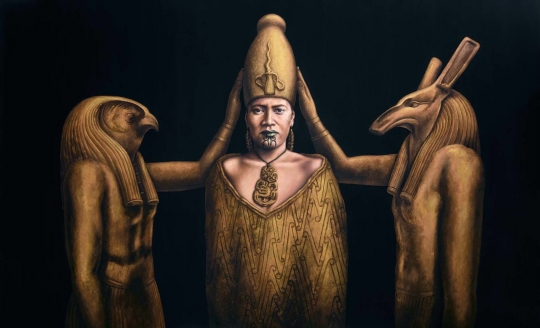
A new print from Auckland artist Sofia Minson was launched today.  It is called "Blessing the Pharaoh" - and from 4pm this afternoon it is available to buy from New Zealand Fine Prints.  To accompany its launch we have been given a superb set of resources about the new artwork, there is a very interesting story of the paintings origins, symbolism and meanings on the listing in our catalogue as well as the video about the making of "Blessing the Pharaoh", a link to which is posted below.

Sofia says "I am drawn to the ever-unfolding wisdom and links between Maori and Egyptian myths, which demonstrate principles of nature in the form of gods and goddesses. Here we weave a new cross-cultural story, yet it is an eternally old one about the transformation of consciousness.”

New Limited Edition Print "Blessing the Pharaoh"
A brief summary of the new work:

● Blessing the Pharaoh is based on the statue in the Cairo Museum of Horus and Seth
blessing the Pharaoh Ramesses III.
● The central figure of the painting embodies atua wahine - divine feminine lunar energy
and is seen as Hine-nui-te-pō, the goddess at the threshold of life and death in Maori
cosmology.
● The image reflects on our human archetypal story of inner sight unifying left and right
brain ways of thinking. The alchemical image ushers in a new state of being where left
brain logic does not rule over right brain holistic thinking, but a higher union of the two is
established.

And as Sofia says, “Before the painter makes their first mark, the blank canvas stares back at them in challenge.”


Lindauer print found in US antique shop with background story about this famous painting

One of the interesting aspects of working at a business with a high profile online is the "unpaid helpdesk" kind of enquiries that flow in via email, over the phone and increasingly through Facebook messenger as well.  These are the enquiries that come to us when a NZ artwork is discovered, about to be sold, or just researched over the internet to find out a bit more about the print or artist.  We deflect enquiries about values of paintings to the right auctioneer for the quality of work/artist and can usually help if a person is trying to work out if an artwork is a painting or a print (what they paid for it is a good place to start!).

Most of these enquiries will not lead to a sale but there doesn't seem too much harm in helping out, hopefully the next time they are thinking about prints they will think of New Zealand Fine Prints.

We got a different kind of enquiry over the weekend from the States.  There a couple of kiwis had discovered a Lindauer maori portrait print in an antique store and they were keen to know if it had originally been sold by us.  What was cool about their enquiry however was that they also emailed a photograph of the label on the reverse of the framed print which had a very well researched blurb about the original painting, the artist and the subject (Rewi Manga Maniopoto) which contained much that was new to us despite having stocked this print for many years. Fascinating to learn that the cloak he is wearing is decorated with the tail hair of specially reared dogs that slept on clean mats to "keep their tails as white as possible"!

It was great to be able to say that we probably sold the print some time over the past 50 years and to thank them for sending us the extra information about this portrait, and that we would put this online for other people interested in this famous portrait to learn more about it:

Rewi Manga Maniopoto


Print of Lindauer's Painting
Rewi Manga Maniapoto, born between  l815 and 1820, was descended from Hioturoa, navigator of the ancestral canoe Tainui, and was an ariki of the Ngati Maniapoto. His tribal lands lay to the south of the Waikato tribe, in the rugged territory of the Waipa and Puniu rivers. From his boyhood, Rewi Manga was fully engaged with the Ngati Maniapoto in inter-tribal warfare.

Rewi Manga is remembered as one of the most popular fighting chiefs of the Maori King Movement. It was he, for instance, who encouraged the participation of Ngati Maniapoto and Waikato people in the Taranaki controversy, ignoring the opposition of the Maori King and Wiremu Tamehana. Rewi and his Ngati Maniapoto people also acted unilaterally in their bid to clear European authority out of the Waikato when they took possession of the Court, the schoolroom and the printing press of John Gorst, the Civil Commissioner of the district, at Te Awamutu.

Rewi's most celebrated action in the Waikato conflict was his last-ditch defence of the Orakau Pa in the heart of Ngati Maniapoto country, in March 1864. The gallantry of that defence has passed into legend. A contemporary report of the event provides a tribute to Rewi Manga's leadership of the federated tribes of the Waikato and Ngati Maniapoto, the Tuhoe of the Urewera, the Ngati Raukawa and Ngati Kahungunu of Hawke's Bay:

No human situation can be conceived more desperate or more hopeless   their lands gone, their race melting away like snow before the sun, and now their own turn come at fast; with enemies surrounding them on all sides . . . this is the last peace and surrender: hoa, ka whawhai tonu ahau ki a koe, ake' (Friend, I shall fight against you for ever and ever). 

In the years following the end of the Waikato war, the Ngati Maniapoto, led by Rewi Manga, together with the Maori King, Tawhiao Matutaera Potatau Te Wherowhero, encouraged Te Kooti to take up the work of routing the European settlers from the land. However, Rewi Manga did eventually renounce his support of Te Kooti in return for the assurances of the government that there would be no further military' operations in the King's territory.

Rewi Manga lived until 1894, through the period which saw the enactment of confiscation and the further decimation of the Maori population.

Lindauer's portrait depicts Rewi Manga in his prime, proudly displaying symbols of his chiefly power, and with full facial moko and huia feathers. He holds a hoeroa, a rare weapon carved from the- lower jaw bone of the sperm whale. His dogskin cloak, a kahu waero, was the most highly prized type of the Classical period. It is a dress mat like a korowai, but so thickly covered with strips of white dogstail that the kaupapa of the cloak is completely concealed by the long-haired bushy tails. This type of cloak was made by fastening strips of tail at one border of the mat, hanging loosely to form a heavy fringe. On the body of the mat, strips were placed along the warp and secured by the weft threads.

Colenso has left a record of the high value of this type of cloak, describing in particular the dogs from which the tails were obtained:

White haired dogs were greatly prized, and were taken the greatest possible care of: They slept in a house on clean mats, so that their precious tails should he kept as white as possible. Their tails were curiously and regularly shaved, and the hair preserved for ornamental use. 

Contemporary Maori artist Douglas Ferris talks about his popular prints

For over a decade prints of Maori artist Douglas Ferris' exquisite pencil sketches have sold steadily to collectors of Maori art throughout NZ and around the world.  Born in Hastings Ferris is from the iwi Ngati Porou.  Douglas is shown here creating one of his portraits in his studio.

Maori artist Douglas Ferris at work in his Hastings studio
We asked Douglas to tell us a bit more about his artistic background and what sparked his interest in Maori portraits in particular.  Ferris told us that he gained his Bachelor's degree in Fine Arts with Honours from Brigham Young University in Hawaii, his wife Charlotte added that "he received the prestigious Top Artist Student Award in 1995 [his last year of study].  Charlotte also told us that Douglas' "informal training began as soon as he was able to hold a pencil and paintbrush.  He has drawn and painted ever since [and] has been doing portraits since primary school".

So why did he focus on portraits of Maori?  Ferris said he had admired "the special spirit that our Maori people innately possess" and that he particularly "enjoyed capturing this human spirit in representational art". Capturing the pride of "our people" in his portraiture is paramount to Douglas. Ferris says he doesn't take it to heart when people criticise him for selling portraits of Maori (see our previous post on the controversy about prints of Maori portraits by Goldie & Lindaur), he gets "thousands of thanks for making it possible for relations to have a picture of their relation".

Ferris' classical art education background sees him looking to masters of representational art such as Carravagio, Rembrandt and Velazquez for inspiration rather than to other contemporary NZ artists and he describes the process of creating his Maori portraits in characteristically straight forward terms "I look, I see, I create".   All of Douglas' prints are held in stock at New Zealand Fine Prints - at just $29.95 each his studies are some of the most popular prints in the Maori art collection with customers often buying several prints at a time to frame as a series.

Prints of Maori Portraits painted by Goldie, Lindauer - Should they be allowed by New Zealand Galleries?

Maori portrait by Goldie

Faced with the dwindling supply of prints of paintings by Charles Frederick Goldie we were talking in the office today about the problems publishers of prints are having with the publication of Maori portraits that are held in some major New Zealand public galleries.

For a long time paintings of Maori subjects have been reproduced as prints. Goldie himself did a handsigned print of "A Good Joke" in the 1920s (which now sell for around $1000 each on the rare occasion they come up at auction). However during a major Goldie exhibition at the Auckland Art Gallery in 1997 some Gallery staff became nervous about the use of Goldie's Maori portraits (on a large calender) after they were questioned about their right to do so by at least one descendant. Since then the idea of seeking permission from descendants of a [Maori] portrait's subject before a painting is reproduced has taken hold at at least two major New Zealand public art galleries. We have heard the term "moral copyright" being used to describe this new idea that if a print is being made of a painting with people in it there is an obligation to trace descendants of the subjects to ask their permission.

Because we stock all Maori portraits available as prints we have descendants of Goldie (and Lindauer) subjects emailing or calling on at least a weekly basis who want to purchase prints of their ancestors that are not currently in print. Print publishers are facing a gallery policy that is inventing a new form of copyright that is not recognised outside of a couple of institutions in New Zealand. We would love to hear views from all sides of the debate about the publication of prints of Maori Portraits - please add your comment to the discussion below.