Slow Death of Kiwiana?

In this article we talk to NZ designer Shann Whitaker of Tantrum Design who has recently declared he thinks the popularity of Kiwiana is just another trend, and a perhaps a fad that is on the verge of dying.  

Whitaker argues that Kiwiana has not just been a relabelling of what is unique to or easily identified as being from New Zealand as "Kiwiana" but a trend that has perhaps done its day. It's an interesting contribution to the debate around whether kiwiana is just another trend that has now possibly been done to death or have we just taken to calling cultural products from NZ that were always there and will always be for sale (tikis for example) with the previously kitschy term Kiwiana?

NZ Designer Shann Whitaker
Kiwiana "Bloated and Swollen", needs "A Cleanout"

Whitaker says "Like every good idea and trend, the good times must come to an end."  Although Kiwiana hasn't yet actually died "It has just become rather bloated and swollen, to a point that every shop, chemist, two dollar store or fair stall has something Kiwiana in it."

Whitaker says that the most important factor in the decline of Kiwiana is time, "it has probably been a good decade since the scene really took off". He adds "Sure, you can still find great creative NZ themed gifts but lets face it, New Zealand has a limited amount of iconic imagery, flora and fauna. There are only so many different ways you can dress up a Fantail before you start going a little crazy. I used to joke that we needed to find some kind of new bird or mammal just so we had something new to design. These same icons have been designed to death now and the regurgitating of the same material is becoming stale."

According to Whitaker Kiwiana needs a "clean out".   He says the "sheer number of creatives trying to design in a small market has become over populated. Copycats, the faux designers ripping off new ideas and selling them at low low prices to cheap stores do not help the market."

Kiwi design is more important than kiwi made to Whitaker

Although he is talking about giftware and design store products more than kiwiana art specifically Whitaker makes an interesting distinction between kiwi made and kiwi designed but manufactured overseas and calls for the buying public to "embrace creatives for their ideas not just their manufacturing abilities."

"I was 100% NZ Made for six years", he says, "but as my ideas changed and I got more adventurous with my products I realised that I was restricted by price. I feel that as New Zealanders our strengths are in our ideas and creativeness. We cannot compete with the low wages and long hours that make China and India  powerhouses of the manufacturing world."

In NZ Fine Prints part of the broader market for cultural products from New Zealand we still believe that the rebranding of the work of NZ artists as kiwiana art is mostly a blurring of the definition of "fine art" from New Zealand and popular or commercial art in the public's perception.  However Shann's assertion that the days of derivative - or less charitably copycat - "kiwiana" style designs being sold everywhere on everything is coming to an end (even if the name still sticks to art that has nothing in common with buzzy bees and four square man beyond being created in the same country) does seem to be common sense too.  What we would be concerned about would be if Kiwiana was both a trend and a blurring of definitions that had the result of quality work by NZ's best artists being dismissed in the near future as merely Kiwiana that is no longer fashionable due to the factors Shann has identified.

Is kiwiana just a trend? If so is "Kiwiana" a trend that is dying? Please leave a comment below.

Brilliant NZ Native Birds Poster published by Te Papa Press

"Native Birds of New Zealand" Poster | Image Credit: Te Papa Press
When Geoff Norman, author of "Buller's Birds of New Zealand: The Complete Works of JG Keulemans", spotted a framed poster of "Native Birds of New Zealand" at his friend Jock Phillip's place (Jock's a well known NZ historian and editor of "Te Ara: The Encyclopedia of New Zealand") he realised this could be the poster that Te Papa Press were looking for to accompany the publication of his award winning book.

It was the perfect poster to accompany his book's launch because the birds in the poster are based on the artwork of JG Keulemans, illustrator of Walter Buller's "A History of the Birds of New Zealand".

The Book
Norman's book "Buller's Birds of New Zealand: The Complete Work of JG Keulemans" (already on its second printing and currently available from bookstores and Te Papa Store) included the complete set of 95 artworks from both editions of ‘A History of the Birds of New Zealand’ by Walter Buller and the subsequent supplement. In the book each bird painting is accompanied by extracts from Buller’s original, descriptive text. It also includes up-to-date taxonomic information in English and te reo Māori, as well as background information about Keulemans and the production of these books.

Hand-coloured prints by watercolour artist Keulemans were first published in 1873 in the first edition of Walter Buller’s iconic book, known colloquially as ‘Buller’s Birds’. Aside from a limited edition released in 1986, this new book is the first time that the full set of these prints of native New Zealand birds has been printed in colour since the nineteenth century.

Buller completed the second edition in 1888, containing new plates, this time using chromolithography, an early form of colour printing. Author Geoff Norman came across the original watercolour proofs for this edition and the subsequent supplement by chance while in the UK.

“I was staying near Tring where the Ornithological Branch of the Natural History Museum is based, and was told about their New Zealand cabinets and also that the original watercolours for ‘Buller’s Birds’ were kept there. I realised how special those paintings were, and when I saw them knew that I wanted to republish them together with the hand-coloured first edition plates,” says Geoff.  “Keulemans’ paintings of our birdlife are bright and luminous and clear. They’re masterpieces. We’re presenting them in this new book at the same size and in the same order as they appear in the original books, but modern scanning and printing means that we are able to reproduce the colour and detail in the way they artist originally intended. I think Keulemans would like what we’ve done with his work.”

The Poster
Jock Phillips had bought a framed version of the "Native Birds of New Zealand" poster from a second hand shop. His copy of the poster had been reprinted in the 1990s by a Dunedin printer that was no longer in business.  Originally the poster was produced as a chromolithograph (a coloured print using a tablets of stone as the printing plates). The designer/artist was William Schmidt (1870-1969). He was born in Auckland and did lithographs for The New Zealand Graphic. His father was John Diedrich Schmidt, a German who was one of the founders of the Melbourne Age before he moved to New Zealand where he set up a business as a printer and engraver.

The poster was scanned but was not touched up or "Photoshopped".  Te Papa Press added a light grey border around the poster and extend the light grey text panel at the bottom to include source material and Te Papa Press details. There are 25 native bird species depicted in the poster and they are identified with tiny numbers and a key at the bottom of the poster that also gives the fraction of natural size at which the birds are reproduced.

This publication is a glorious re-discovery of an unusually decorative and well designed early NZ poster.  Te Papa Press's printers have done a wonderful job of re-printing this poster, "Native Birds of New Zealand" is printed on a superb silken paper stock that does not merely reproduce the original chromolithograph, it reincarnates it!  Copies of this poster are on sale here at NZ Fine Prints.

Gifts from NZ and International Duties/Taxes

New Zealand has a pretty enlightened regime when it comes to customs duty, there are very few categories of products that are subject to import tariffs (duties).  The threshold for the imposition of GST only kicks in when the value of the goods would have a GST component greater than $NZ60, less than this and the cost of collection is deemed to not be worth the extra revenue to the government.

This may change, according to the customs website "Customs, Inland Revenue, and Treasury are currently looking at whether it is feasible to collect GST from overseas online purchases. A discussion paper outlining a range of issues related to online shopping and options for collecting GST is being developed and will be available for public comment later this year.  The Government does not currently collect GST on lower value goods for practical reasons – the administrative costs would be higher than that GST collected. A 2011 review found it was not cost effective to collect GST on items under $400. But if improvements can be made to the way goods cross the border and GST is collected, then the threshold at which benefits of collection outweigh the costs may decrease."

All very well if you are importing goods into NZ or purchasing gifts for friends and family in New Zealand from overseas this Xmas but using a NZ based supplier.

Problems with duties can arise when people order items either for themselves or as gifts from NZ to be delivered to countries with murkier or more oppressive import regimes.  Nobody wants the gift recipient to be landed with the hassle and expense of paying for the privilege of receiving your gift at Xmas! NZ Post has a very expensive product that can be added on to their already pricey Express International Courier service called Delivery Duties and Taxes Paid (DDTP) that "gives you the option to have duties or taxes incurred for parcels charged back to your New Zealand Post Account – this can reduce delays and ensure you pay rather than the recipient." Useful but prohibitively expensive at this time.

NZ Customs Declaration Form
Nearly all gifts NZ Fine prints send outside of NZ use the green customs declaration form for parcels up to 2kg (each print weighs about a 100gms) and are marked as "gift".  No matter what a customer asks us to declare at checkout time we have to itemise the contents of the package at the correct value. It's the law!

However there are a couple of things we can do to help your parcel get through without attracting duty at the other end.

1. The sheer volume of Xmas mail to countries like the US and UK means that not every parcel is going to attract the attention of customs.   Non-commercial mail is often treated more leniently, so we can hand address the parcel AND use your name and address as the sender rather than "New Zealand Fine Prints" or "Prints.co.nz" if the value of your gift is over the threshold.

2. The other option is a gift voucher - these are sent via email or post and the recipient will be able to receive the full value of your gift without customs being involved.

In practice the rapid growth in online sales coupled with the impossibility of screening every package means that nearly all gifts sent by us are delivered without attracting duty at the other end. Australia has an uncommonly lenient regime which is a huge bonus for New Zealanders sending gifts to the one place that has more kiwis than any other country outside of NZ - if your gift is under $AU 1000 there is zero duty or GST going into Australia.

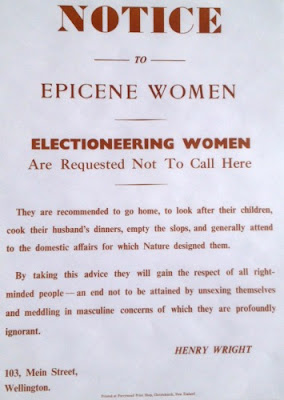
Historic "Epicene Women" letterpress poster opposing women's suffrage in NZ

This well known poster "Notice to Epicene Women" from Wellington identity Henry Wright is an amusing artefact from the fight for women's right to vote in New Zealand.  NZ was the first country in the world that had universal suffrage with an Electoral Act enfranchising women becoming law on 19th September 1893.

Vintage NZ Letterpress Poster "Notice to Epicene Women"
NZ Anti-suffrage poster "Notice to Epicene Women"*
(You can buy an authentic letterpress re-print here)

The National Library has dated this poster's printing to November 1902 citing an extract from the New Zealand free lance 22 November 1902, page 6: "I wonder who "Henry Wright" is? He has issued a circular to "Epicene Women", who are interested in the elections, asking them not to call on him, but to stay at home and cook their husbands' dinners, and other things. Evidently a woman hater. Oh well, it is delightful to have such frank gentlemen living in Wellington. I am interested in the elections but I shall not call for "Henry Wright's" vote. There appears to be nothing epicene about him".

However an anonymous researcher has added a note to the bottom of the re-issued letterpress poster that the notice was first used to deter campaigners door knocking for a series of massive petitions that had gathered the signatures of nearly a quarter of the adult European female population of New Zealand by 1893.  [The term "electioneering women" would not have referred to women standing for Parliament and door knocking for votes as women were barred from standing for Parliament in NZ until 1919.]

Both the earlier and later usage dates could be correct if Mr Wright (and others - there is no record of how the size of the original print run) continued to provoke people with his poster for some years after the passing of the Electoral Act into law.  But the actual date of first printing is almost certainly around 1893 rather than the National Library's date of 1902, it seems unlikely that even the most hidebound reactionary would still be bearing a grudge of such lasting intensity about women being allowed to vote a decade after the Electoral Act was passed  that they would commission such a poster for its first use as late as the 1902 election.

Henry Wright
So who was Henry Wright? Henry Wright was a Wellington debt collector and business identity, here he is in a cartoon published alongside the following verse in Truth September 26 1914.

A well-known man is Henry Wright.
Though "stoney" [broke] blokes shun him as a blight.
His spats and his hat
Just suit him quite pat
While his dress but reflects
His fondness for "checks"
And its little he recks
That many a woe-worn bankrupt might
solemnly swear he's "The Wrong Mr Wright"

The Evening Post characterised Wright at the time of his death at the age of 92 in 1936 as "one of the city's best-known figures. He has been described as the most benevolent looking professional debt-collector in the world. He was usually dressed in a belltopper, frock coat, and check trousers, with brightly-coloured tie and an opal pin."

This unique piece of NZ reactionary political propaganda has recently been re-printed using the traditional letterpress method (with moveable type laid by hand) by the letterpress enthusiasts at the Ferrymead Print Studio, the home of a superb collection of vintage printing equipment kept in working order entirely by volunteers.  For sale at just $9.95 in NZ Fine Prints' vintage poster collection.

Special thanks to the "Papers Past" digital repository of New Zealand newspaper archives for enabling this writer to research this article on the background of the man behind this old poster.

*The full text of the poster reads:

Notice to Epicene Women

Electioneering Women are requested not to call here

They are recommended to go home, to look after their children, 
cook their husband's dinners, empty the slops, and generally attend
 to the domestic affairs for which Nature designed them.

By taking this advice they will gain the respect of all right-
minded people - an end not to be attained by unsexing themselves
and meddling in the masculine concerns of which they are profoundly ignorant.

Henry Wright 103 Mein Street, Wellington.

Story of a print of New Plymouth that appeared in the British Parliamentary Papers

Gully, John 1819-1888 :New Plymouth, New Zealand. [London] Day & Son [1860].
Ref: B-051-015. Alexander Turnbull Library, Wellington, New Zealand. 
http://natlib.govt.nz/records/22326669
This rare print is the only New Zealand view to appear in a British Parliamentary paper in the period up to 1875 (the period covered by Ellis "Early Prints of New Zealand").  It was re-printed by Avon Fine Prints in the 1960s and the original watercolour that the print is based on by painter John Gully is in the National Archives.

The print accompanied a despatch from Governor Gore Browne dated 13 March 1860 and appears in Command paper 2798, 1861: "Papers relating to the recent disturbance in New Zealand."

The description of New Plymouth which accompanies the view is not particularly complimentary about the new settlement.

"The town consists of a struggling village on a skirt of flat land, which is enclosed and commanded by a higher table land encircling the town in the form of a crescent. One end of this crescent is Marsland  Hill, on which the barrack stands, and on the other extreme we are about to erect a stockade. The intervening space between the barrack and this block-house is about three quarters of a mile, but the ground is broken by ravines and swamps and covered with fern, so that what is delineated in the New Zealand Company's plan as squares and streets is in reality wild land, much tormented, and well adapted to cover and conceal the approach of an enemy. Isolated cottages dotted about at intervals, the town being confined to little more than a single street on the shore.

The inland country generally is covered with high fern and dense forest, some of which is almost impenetrable to Europeans, and is everywhere broken by ravines and streams which are thrown off Mount Egmont [Taranaki]. There is a native pah in New Plymouth . . . and there are numerous pahs in every direction . . . 

The proposed blockhouses, which look so imposing in the sketch, may be described as wooden guard-houses, large enough to contain twenty men each. They are not yet constructed."

The view was redrawn for Sir James Alexander's Incidents of the Maori War, 1863

Mr John Gully
The Nelson Provincial Museum, Davis Collection: 1138
John Gully was a major New Zealand artist - according to Una Platts "Nineteenth Century NZ Artists" probably the most popular of his time.  Gully was born in Bath, England. He was apprenticed to an iron foundry and graduated next to the designing and drafting department. However this did not satisfy the young Gully's ambition and he spent periods as clerk in a savings bank and worked in his father's business. Gully took private lessons in painting during this time. In 1852 he and his wife and children emigrated on the John Phillips to New Plymouth.

In 1858 "J.G. of Omata" was advertising ready to paint "views" of properties for sending overseas. He farmed at Omata and worked as a clerk in New Plymouth. Gully took part as a volunteer in the Taranaki wars but was invalided out of the Army. In 1860 Gully and his family moved to Nelson where he settled permanently.  Gully was Drawing Master at Nelson College, then draughtsman in the Lands & Survey Office.

In 1863 two of his paintings, one a wreck of the Lord Worsley, one a view of Mount Egmont were advertised for sale. The encouragement given him by von Haast, whose "outlines" of mountains he coloured, and by the painter J. C. Richmond, then Commissioner of Crown Lands, was probably the turning point of his career. Richmond went on painting expeditions with him and used all his influence to make Gully's work known. In 1865 Richmond enlisted the help of his brother, C. W. Richmond, then a judge in Dunedin, to get his own and Gully's work to the NZ Exhibition and to see that people knew that Gully was ready to paint professionally.

By 1870 Gully was probably the most popular painter in the New Zealand. He exhibited watercolours at the Intercolonial Ex Melbourne 1866-67. In 1878 retired from the Lands & Survey Office and began to spend his full time painting and was listed as a Nelson artist in Wise's directory.  John Gully nearly always in watercolour and was greatly praised for his ''atmospheric effects". In the NZ and South Seas Ex Dunedin 1889-90, a group of watercolours by the "late Mr Gully" were shown as a special exhibit. Exhibited: Fine Arts Association Wellington 1883, NZ Academy of Fine Arts 1889, Melbourne International Ex 1880-81, Centennial Ex, Melbourne 1888-89.  Paintings included in Centennial Exhibition in Wellington1940. Represented extensively in Nelson's Bishop Suter art gallery, and Gully's paintings are in most gallery and library collections throughout NZ today.